Empire, the town that is the setting for my upcoming series The Carpe Diem Café, is in southwestern Ontario. It doesn’t exist, but it’s important to me that the details be right, so it *could* exist.
I always have to have a map of my fictional worlds, and Empire is no different. I’ve been steadily adding details to Empire’s map for a while – and that’s sent me down some research avenues to get the details right.
The towns in this corner of the world were established by practical people, most of whom came from the UK. In fact, there were a lot of Scots laying out and claiming territory here. Many towns, as a result, have a Caledonia Street. Many also have a Britannia Street and a Hibernia Street.
The main street of an older town also offers a hint as to when the town was founded. If it was during the reign of Queen Victoria (1837 – 1901), that main street will usually be called Queen Street. If a town was founded during the reign of William IV (1830 – 1837) or Edward VII (1901 – 1910), the main street is likely called King Street. Many towns have both a King Street and a Queen Street. (Toronto has a Front Street, which was along the edge of Lake Ontario – although now it’s not. Toronto’s harbour has been augmented and extended with landfill, so the shore isn’t where it used to be.)
Roads that radiate out from a town are often named for their destination. Erie Street will end at Lake Erie. Huron Street will end at Lake Huron. Exeter Street will take you to Exeter. Guelph Line takes you to (surprise) Guelph.
In addition, towns often have the names of places originally located in the UK. The biggest cities regionally are London and Windsor, but there are plenty of smaller ones, undoubtedly named after “home”.
There’s more in a name than that. Any town that begins with the word Port, was once a port. We don’t always think of towns on the Great Lakes as ports, but boats were the easiest way to move freight and people for a long time. The railway didn’t come to this corner of the world until 1850 – the Canada Southern Railway opened in 1872 from Amherstburg to St. Thomas – so ships were the way to send goods. There were steamers and ferries – heading across to the US – fishing ships and freight barges. Ice was harvested from the middle of the lakes in winter, for iceboxes and cold storage.
Also, a lot of the ports, especially along the north shore of Lake Erie, had parts to play in the War of 1812. That gives us another population element – the United Empire Loyalists who moved from the young United States to the colonies of British North America during that conflict. Many of these people were originally from the UK, but others were from other European countries with monarchies, whose origins shaped their ideas about government. There were also financial inducements to making the move. Loyalists were given allotments of land by the crown – another incentive was that taxes were lower in the British colonies than in the US. (Wiki says they were 25% of US tax rates.) Here’s a quote from Wiki about the population in the early 19th century:
By the outbreak of the War of 1812, of the 110,000 inhabitants of Upper Canada, 20,000 were the initial Loyalists, 60,000 were later American immigrants and their descendants, and 30,000 were immigrants from the UK, their descendants or from the Old Province of Quebec.
There were ship battles on Lake Erie during the war, and there are sunken shipwrecks, too. Because there were no locks at the time to make passage between the Great Lakes possible, all of the component parts of a ship would be delivered to a port, and the ship assembled there to set sail on the lakes and wage war.
After the war of 1812, stories of free Black men in British North America reached people of color in the US. By the 1830’s the Underground Railway was in operation, offering a dangerous opportunity for slaves to escape to freedom. Like the Loyalists before them, some of these people came by train, by wagon, by boat or on foot. Remember that in the winter, sections of the Great Lakes would freeze – esp Lake Erie, which is shallow – and people could walk across the border. (Some of my own forebears were United Empire Loyalists who walked across the frozen St. Lawrence River to a new life.)
Here’s an excerpt from the Canadian Encyclopedia with statistics.
An estimated 30,000 to 40,000 freedom seekers entered Canada during the last decades of enslavement in the US. Between 1850 and 1860 alone, 15,000 to 20,000 fugitives reached the Province of Canada. It became the main terminus of the Underground Railroad. The newcomers migrated to various parts of what is now Ontario. This included Niagara Falls, Buxton, Chatham, Owen Sound, Windsor, Sandwich (now part of Windsor), Hamilton, Brantford, London, Oakville and Toronto.
This gives Empire another bit of history. A number of the safehouses used by the Underground Railroad are preserved as museums, or at least their history is known, so I’ll figure out which house and family in Empire was part of that story.
All of this history, of course, overlays a much older history, one that occurred far earlier than the 19th century. These locations already were named by the indigenous people who lived here before the arrival of the Europeans. That’s another layer that I still need to explore and add to my fictional realm. The first settlers in the area were French missionaries, so I’ve that to explore, too. I’ve made it back 200 years or so, and am still digging – but look at all the details I’ve already found to play with.
The ports were usually named after an influential person in the region or the one who established the town. Empire has a sister town of Port Cavendish, the original port established by the Cavendish family in the area. By the time of our series, its harbor is used by yachts and pleasure boats, and its sandy beach is popular with vacationers. There are cottages and mobile homes, a convenience store and a bird sanctuary. Port Cavendish is even more sleepy than Empire, but the residents like it that way.
I have a working map of Empire now, which I made pretty this past weekend. There will be more additions, but this is a good place to start – there’s also a little glitch with some intersections not connecting, but I’m hoping to get that fixed soon:

Pre-order your copy of Just Trouble, book one of The Carpe Diem Café series of contemporary romances, today!
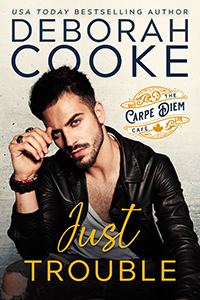
If I recognize trouble when I see it, it’s because I grew up with a huge crush on my best friend’s older brother, Luke Jones. Born with sinful good looks and enough charm to talk himself out of almost any situation, he’s always been a rebel with attitude to spare—as well as gorgeous, reckless and dangerous for good girls like me to know. Though he’s found fame, fortune and all the fan-girls with his band, Luke remains the star of all my secret fantasies.
But now, he’s back—one sizzling look is enough to set my world on fire— and he wants a favor. (From me!) Time to make the world a better place, Luke says, but I recognize half a story when I hear one. Does it really matter? I need to ditch this crush before it’s too late for me to fall in love for real and find my own happy ending. Luke doesn’t need to know that it’ll be more than a favour for me. He also won’t linger in the sleepy little town of Empire, and when Luke leaves this time, he’ll be gone forever.
The problem is that the other half of the story is the kind of revelation that hooks me hard. Luke’s on a quest to right old wrongs, and making the world a better place is pretty much my theme song. Am I crazy to hope for more from the man who has only ever committed to his music? By the time I learn the whole truth, will my heart be lost forever? For once, though, I’m not going to play it safe. Win or lose, my time to seize the moment is now.
Coming in February 2025
Pre-order available at some portals:


Just Trouble will also have two cover designs. The ebook at retailers and the mass market print edition will have Luke on the cover, as shown above.
The trade paperback at retailers will have the alternative cover with the illustration of Luke and Daphne at right. The ebook will be available with the alternate cover in my online store, as well.
You can pre-order it now.


 Deborah Cooke: Author