For today’s writing and publishing post, I thought I’d talk a bit about balance. A writer’s life is a balancing act, as most people’s lives are. There are tasks that must be done on time, chores that have to be completed regularly and there is the joyous part of doing what we do best. But even the joyous part of writing requires some balance. Most writers don’t write well or are less productive when there is stress in their professional or private life, or when they are out of balance. Burn out is a possibility if we push too hard too fast.
Julia Cameron’s book THE ARTIST’S WAY is quite a brilliant resource for those of you who have tasted burn out. I first did the exercises in this book when I was almost completely worn out by publishing and its demands, and it was a wonderful restorative. Now I do the exercises annually (it’s a 12 week program) to ensure that I never get to that ugly place again. One of the ways she talks about ensuring your balance is called ‘stocking the well’. Ideas don’t come out of nothing. They come from images and experiences and interactions with the world. So, part of ensuring that you have lots to write and lots of ideas is getting away from your desk regularly and finding some new fishies for your well.
One of the most grounding things for me is time in the kitchen. I love to cook and I love to make preserves. This past weekend, I finished up my year of preserving by making quince jelly. Quinces are magical fruits. They are kind of like pears and kind of like apples, but not exactly like either. They have a wonderful evocative perfume. They start out pale yellow but the longer you cook them, the more pink they become. And one of the things I really like about quinces is that they have stories.
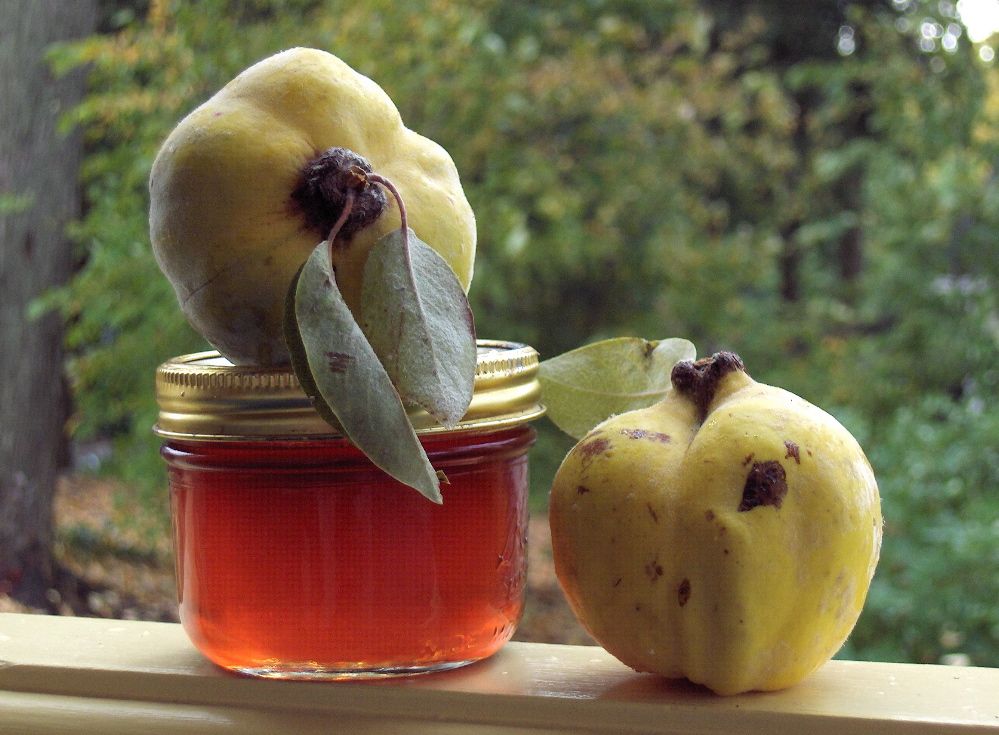
Quinces are an ancient fruit, perhaps the most ancient fruit. They come originally from Mesopotamia. They are tart and they are hard – evidently they are also resistant to pests and blight. This tree is a survivor. There is a suggestion that the golden apples of Hesperides, treasured by men and gods, might have been quinces. There’s also an idea that Eve might have taken a quince instead of an apple. The Owl and the Pussycat dined upon slices of quince, according to Edward Lear. Marmelade was originally a quince jam – marmelo is the Portuguese word for quince. Membrillo is a paste made of quinces eaten in Spain and its former colonies with manchego cheese. The French make a candy of it, pate de coings, which is a digestive. Stewed quince, cooked until it is red, and preserved like jam is called muraba in Pakistan. Mr. Math likes to tell me about the officer on the expedition of Ferdinand Magellan, who took along his private stash of quince jelly. He was the only one on the ship who did not contract scurvy – because quinces have lots of Vitamin C.
Making quince jelly gives me a great deal to think about, as well as filling the house with a wonderful perfume. I buy mine from a local farmer who says no one wants them much but me, which suits me just fine. He has an old tree on his farm, probably one planted from a shoot brought from Europe by a settler in the 19th century.
If you want to make quince jelly, you’ll need quinces. Get them when they are a bit greenish, and they’ll have grey down on them. They won’t be too fragrant yet, but they’ll have lots of acidity to help the jelly set. You can just chop them up for jelly – don’t worry about pits or skins. Put the chopped quince in a pot and cover the fruit with water. Bring it to a boil. It’ll look like applesauce soon, but keep boiling it until it turns pink. The longer you cook it, the pinker it will get. (This is magic.) Cool the mash, then strain it through a jelly bag. Measure the resulting juice. Put it in a pot with that much sugar and half again – for example, I had eight cups of juice and mixed it with twelve cups of white sugar. Add some lemon juice, maybe 1/4 cup. Cook to the jellying point.
This should set, if your quinces are a bit green. The lemon juice helps. But if you prefer insurance, like me, then use commercial pectin and follow its directions to finish the jam. I had one last package of commercial pectin in the cupboard so used it up on my jelly. We’re safe from scurvy for another year – and I’ve done some thinking about European cuisine and Mesopotamian stories. Lots of new (pink) fishies in my well this week.
What do you do to restock your well – either to rejuvenate yourself or to find new ideas?


 Deborah Cooke: Author
2 responses to “Balance”
I’ve never had a quince and now I want one more than anything.
I’m not sure what I do for balance. It’s not something anyone has ever accused me of. I do can. This year I made mixed berry jams and zucchini relish. And there’s the knitting–although not so much lately now that I’m in school and have *gulp* homework.
LikeLike
I first encountered quince in Japan. They preserve thin slices in shochu http://en.wikipedia.org/wiki/Sh%C5%8Dch%C5%AB
and sugar, then use it by the spoonful to treat colds when you first get that nose and throat tickle. It works great!
I made it myself using whatever alcohl we had on hand before i became hyper sensitive to citric acid, and it cured many a cold over the years.
LikeLike