I find tarot cards quite intriguing, although I’m not that good at reading them. (I have to look everything up, then work from there.) But even so, my cards do tell me things, sometimes things I’d rather not know, and are a resource I consult every once in a while.
It’s not clear how old tarot cards are. There are decks which survive from the 15th century and there are 15th century references to them – they were used to play a specific card game called tarocchini or tarot. The official story is that they were adopted for divination later, but there certainly are people convinced not only that the cards have older origins than this but that they were always intended for divination.
A typical tarot card deck has 78 cards. The main body of the deck is the minor arcana. Within this, there are four suits of 14 cards each – numbered 1 through 10, then a page, a knight, a queen and a king. The suits are rods (which govern work matters) coins or pentacles (which govern money), cups (which govern affairs of the heart) and swords (which govern conflict).
If this sounds a lot like the playing cards you already know, that’s because our 52-card playing deck is derived from the tarot. The page was dumped in the transition and the knight became a jack. Cups became hearts; rods became spades; coins or pentacles became diamonds; swords became clubs. It’s easy to see how a talented card reader would still be able to use a 52-card deck to tell fortunes.
The other distinguishing characteristic of a tarot deck is the inclusion of the higher arcana cards. These are the ‘court cards’, the 21-card suit of trump cards with specific names. Their appearance in a reading indicates importance – either of the question itself or the magnitude of the querant’s choice. The intriguing thing about tarot cards is that they are supposed to indicate the current view of the future, given the choices at hand. So, they’re a good resource for questions like “should I take this job?” or more accurately “will this job allow me to achieve my goals?” Of course, the future is always in flux – everyone’s choices are constantly shaping it. I like to see how that is mirrored in the cards, and also how they respond to the energy of the people present.
They shouldn’t work. They’re pieces of cardboard with pictures on them. But they often do work, and that’s fascinating.
I am also amused that my two decks have such very different personalities. My full deck – which has lovely Renaissance illustrations based upon the Visconti-Sforza tarot deck from the 15th century – is fond of showing all the nuances relevant to the reply. The abbreviated deck, which is a variation of the traditional tarot, is blunt. It likes short questions and gives pithy replies. It makes me laugh.
I’ve often included tarot cards in my stories, just because they are so neat. In one of my Claire Cross books, LOVE POTION #9, the heroine, Lilith, is a Gypsy who has read tarot cards all of her life. They are completely familiar to her, not mystical at all but simply a part of her life. I loved how intuitive Lilith was with them and how reliant she was upon them.
It made sense to structure the book – which was really her story – accordingly. That book has 21 chapters, each one named after a card in the higher arcana. I took them in order, and the card of choice governed the action in that chapter. This was quite a challenge – I didn’t even think of it until the book was about half done and I was reading more about the journey one can follow by using the cards. I realized then that a lot of what I had written did line up with the cards, and so the challenge was on to make it all work. I had a great time writing that book.
More recently, I’ve been using tarot cards in The Dragon Diaries. There’s a continuing character who is learning to read them – no, I won’t tell you who! – and I enjoy the way that this character is feeling the way forward with them. The relationship isn’t nearly as intuitive as Lilith’s in LOVE POTION #9, but then these characters aren’t centuries old! The cards seem to open a portal to a deeper understanding in these books, which is certainly consistent with my relationship with my cards.
Here’s the Wiki on tarot, in case you want to read more.
Here’s where you’ll find more information about my re-release, LOVE POTION #9. (Scroll down to this cover.)
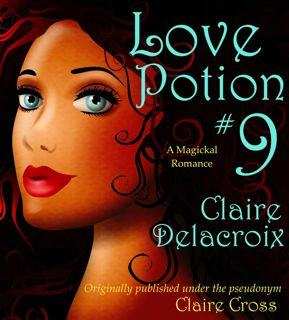
Do you read tarot cards? Do you believe that they work? Do you believe in any kind of divination? Have you ever had your fortune told and learned something surprising as a result?

 Deborah Cooke: Author
4 responses to “Tarot Talk”
Deb, i LOVE tarot cards. I think they are magical, and spiritual. The only tarot reading i have ever had done, was really kind of spot on- thinking back on it.
I have an oracle deck, which is different from tarot, but still fuctions on the same sort of level. I love them. The art on them is by jasmine becket griffith, one of my favourite artist’s which is why i wanted them, but now i am so attached to doing my ‘card of the day’ something i thought would be nice- to see a nice pic every day- and sometimes, more often than not they are spookily correct in what their divination message is!
Ive not given myself a reading yet- i only got them at christmas and have’nt figured it all out yet, but i do think they are special and love them 😀
Looking forward now to find out who is learning the tarot in the Dragon Diaries!!
LikeLike
I use the Dragon Deck….*big surprise there* ^_^
I’ve done my own and several others and its never done me wrong…I don’t use them all that often it is always nice to take a look and see what I get…as of date they have NEVER been wrong which is kind of creepy I suppose but I still enjoy it…..
LikeLike
I’ve never been exposed to them, other than peripherally through books and movies. I don’t discount their capability, but I’ve never had a reading or anything to vouch for their accuracy. Might be fun to see what would turn up – or maybe I wouldn’t want to know?
LikeLike
I’ve read tarot for years (I bet you aren’t surprised LOL) And it does indeed become instinctive the longer you read them. The sweet spot for me was when the individual card meanings became my own, no longer those of the instruction manual. Of course there is a commonality between the meanings I learned from the manual and those that jump out at me today, but my reading accuracy improved dramatically when the cards became my own, so to speak.
I use the deck created by Ellen Cannon most often, but enjoy trying out different decks.
In many ways it is easier to read for a stranger than for a friend. The slate is clean and the symbology seems clearer.
Some have posited that the accuracy of tarot cards has something to do with the concept of “Indira’s net” or Jungian archetypes.
LikeLike