Yesterday, we closed with a passage and you were challenged to identify which of the three writers whose voices we heard yesterday had written that passage. It was pretty easy and most of you were correct that it was written by Tom Robbins. It was from his book, Skinny Legs and All.
Now we move on to Exercise B. Again, I’m choosing authors from outside the romance section because they may not be familiar to you, so you may listen more closely to their voices. I would call all of these authors fabulists or magical realists, which means they’re all writing commercial fiction in which the world we know is embued with fantasy elements. It’s alive in a magical or mythic way.
Here’s the first one:
“And the only sound in the empty snow-covered valley was my own breathing and the rattling shriek of my dying mare who lay yards away from me.
I’m not sure I had my reason. I’m not sure the things that went through my mind were thoughts. I wanted to drop down in the snow, and yet I was walking away from the dead wolves towards the dying horse.
As I came close to her, she lifted her neck, straining to rise up on her front legs, and gave one of those shrill trumpeting pleas again. The sound bounced off the mountains. It seemed to reach heaven. And I stood staring at her, staring at her dark broken body against the whiteness of the snow, the dead hindquarters and the struggling forelegs, the nose lifted skyward, ears pressed back, and the huge innocent eyes rolling up into her head as the rattling cry came out of her. She was like an insect half mashed into a floor, but she was no insect.
She was my struggling, suffering mare. She tried to lift herself again.
I took my rifle from the saddle. I loaded it. And as she lay tossing her head, trying vainly to lift herself once more with that shrill trumpeting, I shot her through the heart.”
As previously, take a moment to record your impressions before you read mine.
I find this a potent scene, emotionally charged. The language is sensuous and lush. The tone is a bit dark.
This was written by Anne Rice, excerpted from her book The Vampire Lestat.
Here’s another author with a different and distinctive voice:
“My father lost me to The Beast at cards.
There’s a special madness strikes travellers from the North when they reach the lovely land where the lemon trees grow. We come from countries of cold weather; at home, we are at war with nature but here, ah! you think you’ve come to the blessed plot where the lion lies down with the lamb. Everything flowers; no harsh wind stirs the voluptuous air. The sun spills fruit for you. And the deathly, sensual lethargy of the sweet South infects the starved brain; it gasps :’Luxury! more luxury!’ But then the snow comes, you cannot escape it, it followed us from Russia as if it ran behind our carriage, and in this dark, bitter city has caught up with us at last, flocking against the windowpanes to mock my father’s expectations of perpetual pleasure as the veins in his forehead stand out and throb, his hands shake as he deals the Devil’s picture books.”
One more time, record your own impressions before reading mine.
There are longer sentences in this passage and the tone is more literary. It is also sensual and dark. This author wrote a number of revisionist fairy tales with a feminist flavour.
It’s from a short story called “The Tiger’s Bride” in Angela Carter’s anthology The Bloody Chamber.
You probably noticed that both of these last two passages were in first person POV. To me, in both cases, the author’s voice was ascendant, but that’s not always the case. It depends on the strength of the POV character’s voice – both of these books were published before deep POV was so fashionable in fiction and you can see that in the prose.
But here’s another variable for you to consider, one that is of particular importance now that deep POV is fashionable. Voice is not always expressed at a consistent level. Think about this – if you have a strong voice and you stand in the corner and yell, it’s not going to take long for people to get tired of listening to you. In a sense, I believe this is what happened to Chick-Lit. The voice was so strong and so distinctive in that sub-genre that readers hit a tolerance level. They could only read so many books in that voice before they moved on. The actual number of books might vary from reader to reader, but there was an exhaustion factor.
So, let’s look at voice as a tool and one you can use in varying quantities for emphasis.
In this next excerpt something interesting happens halfway through. Something changes with the voice. I want you to listen and see if you can tell me what it is:
“The aunts don’t bother to answer; they have very little tolerance for dim-witted humor, and they’re not interested in making polite conversation. They stand on the corner near the bus station and whistle for a taxi; as soon as one pulls over, they tell the driver exactly where to go — along the Turnpike for seven miles, past the mall and the shopping centers, past the Chinese restaurant and the deli and the ice cream shop where Antonia has worked this summer. The aunts smell like lavender and sulfur, a disquieting mixture, and maybe that’s the reason the taxi driver holds the door open for them when they arrive at Sally’s house, even though they didn’t bother to tip him. The aunts don’t believe in tips, and they never have. They believe in earning your worth and doing the job right. And when you come right down to it, that’s what they’re here for.
Sally offered to pick them up at the bus station, but the aunts would have none of that. They can get around just fine on their own. They prefer to come to a place slowly, and that’s what they’re doing now. The lawns are wet, and the air is motionless and thick, the way it always is before a storm. A haze hangs over the houses and the chimney tops. The aunts stand in Sally’s driveway, between the Honda and Jimmy’s Oldsmobile, their black suitcases set down beside them. They close their eyes, to get a sense of this place. In the poplar trees, the sparrows watch with interest. The spiders stop spinning their webs. The rain will begin after midnight, on this the aunts agree. It will fall in sheets, like rivers of glass. It will fall until the whole world seems silver and turned upside down. You can feel such things when you have rheumatism, or when you’ve lived as long as the aunts have.”
Again, make your notes before reading mine.
First, the voice itself is light, charming. I think of this author’s metaphors as “domestic”, for lack of a better word. It’s accessible and entertaining as well. But did you hear it change?
In the first part of the excerpt, even though it’s not dialogue, the author has let the voice of the aunts dominate the passage. (They really only have one voice, even though there are two of them.) “The aunts don’t believe in tips, and they never have.” The cadence is more clipped, you can hear an elderly person speaking exactly like this.
Then, as soon as the aunts arrive at Sally’s house, the voice changes. The author’s voice then dominates. “The lawns are wet, and the air is motionless and thick, the way it always is before a storm.” It’s slower, more leisurely, more evocative. The rhythm is different, although the excerpt is all of a piece.
In terms of craft, this is a perfect example of using voice for emphasis. The aunts have been summoned to solve a problem, essentially to resolve the plot. This is the big finish. While they are in transit, the author lets their voice claim the passage. It’s also a way of getting double work out of the travelling passage – logistics always make for boring prose. Charged with the aunts’ voice, that paragraph does double duty – it shows the character of the aunts right before they play a key role. Once they arrive, once the big moment is upon us, their voice is subverted to that of the author.
This use of voice is a signal from the author to the reader that it’s time to sit up and pay attention. The dominance of the author’s voice emphasizes the passage from that point onward, because what happens is important. We recognize this intuitively and it’s possible that the author even chose to do it intuitively. But you can do it on purpose, because it works.
The excerpt was from Alice Hoffman’s Practical Magic.
Now here’s the test excerpt written by one of these three female authors. See if you can recognize who wrote it. It has a similar break to the Alice Hoffman excerpt, so don’t give up until you’ve read the last paragraph.
“We stopped on the way back for some wine and a load of delicacies — caviar and crackers, apples, sour cream, smoked oysters. I bought some cinnamon and butter and bread, lots of French yogurt, a cold bottle of Dom Perignon (the best they had, $50) and a package of liquor store wine glasses.
When we got to the room, I ordered an ice bucket, turned off the air conditioner again, and latched the shutters the way I had the first time.
It was just getting dusk, vivid, sweet New Orleans dusk with the sky blood red and the pink oleander glowing in the tangle of the garden. The heat lingered in the air the way it never does on the coast. There was a velvety feel to the warmth and the room was full of dusty shadows.”
Did you hear the change? What was happening there? We had a shopping list, a bunch of details that the reader apparently needs to know but that aren’t the main point of the scene. This author did not put that passage to work by charging it with the character’s voice. It’s info you need, delivered short and sweet. The subsequent seduction is what’s important, so once the characters are back in their room, the author’s voice takes over. “Listen up! Here comes the good stuff.”
So, here’s a craft secret about voice. Voice should not be consistent throughout the entire manuscript as discussed. But your voice should be strongest at the most critical points of the plot. In fact, the strong use of the author’s voice signals a turning point.
Again, we’ll do this part of the workshop in the comments. Tell me who you think wrote this last passage and why. The options are:
• Anne Rice
• Angela Carter
• Alice Hoffman

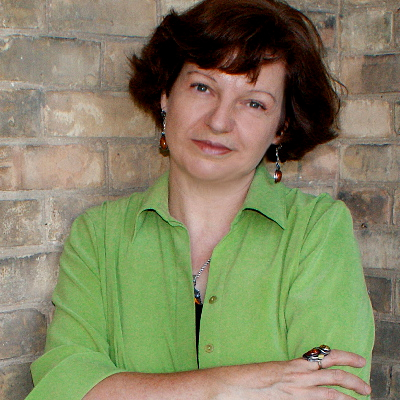
 Deborah Cooke: Author