This is the workshop I taught at New Jersey RWA’s conference. It’s 45 minutes long, so I’ll break it into smaller posts. Here we go!
The Holy Grail of “Voice”
by Deborah Cooke
As authors, we hear a lot about “voice”. You’ve probably been to a few sessions here where the editors and agents have said that they’re looking for “new voices”, maybe even “fresh new voices”. “Voice” is what is supposed to distinguish an author destined for stardom from everyone else. What is frustrating to many authors is that most of these industry professionals can’t or won’t define “voice” in clear terms. Like “scope” and “fresh”, they say that they know “voice” when they see it on the page.
So, what is “voice”? How do you know whether you have a strong “voice”? And perhaps most importantly, if you don’t have a strong “voice”, where do you find one?
The title of this workshop may have given you a clue that I don’t have an easy answer for these questions. I chose the title for a reason, and not just because I’m a medievalist with a fondness for adventure stories. This would be an analogy. You probably know the story of the quest of the Holy Grail – a group of knights gathered at the castle of King Arthur agree to go out and seek the Holy Grail. The Holy Grail in these vernacular tales – which are the medieval equivalent of “bestsellers” – is either a vessel of plenty or it is the chalice in which Joseph of Arimathea captured the blood of Jesus while he was dying on the cross, or it’s both. These knights set out on their quest, either individually or in groups. They think it will be pretty straight-forward, like a treasure hunt. They end up on spiritual missions, usually trying to prove themselves worthy of finding the Grail. The Grail is elusive and mysterious, there are fantastical beings to be defeated and tests of valour, a lot of Christian and pagan elements mix it up along the way, and in the end, only one knight gets the prize. Depending which version of the story you read, a different knight will find the Grail.
So, my analogy here is between writers seeking their voices and those knights riding off to seek the Grail. There’s no map for either adventure and the quest will vary enormously from one writer to another, just as it varied from one knight to another. There also is a subjectivity to all of this – one writer may be told by one editor that she has an unmarketable or weak voice, while another editor might declare the same voice to be the freshest one she’s heard in years. Because this is a personal journey and because the markers are subjective, I can’t tell you exactly how to find your voice. The analogy holds because Merlin and the other advisors to the Round Table in the medieval stories couldn’t tell the knights how to find the Holy Grail either. Like Merlin, I can give you some idea as to what voice is, how to recognize it when you see it, and give you some ideas of where to start looking for yours. So, sharpen your sword and put on your best armour, say a prayer and off we’ll go.
I. Defining “Voice”.
Voice is a distinctive tone to a work. It’s what makes the work different from other similar works, and it is peculiar to fiction. This is both simple and complicated. Think of the way you recognize the voice or the laughter of a friend – you can often do this on the telephone in a word or two. It’s not just accent or pitch that makes a voice distinct. It can be a typical choice of words, or a characteristic way of describing things. Just as it’s hard to pinpoint the exact combination of elements that let you recognize the sound of someone’s voice, it’s difficult to precisely define the elements of a writer’s voice.
But we’ll try anyway.
Here are several typical components of voice, from broadest overview to narrowest scope:
a/ the overall tone of the author’s work. This might vary from work to work, but there will be common elements throughout all of the author’s work. Some authors are always funny or irreverent, while others have voices that are more evocative and romantic.
b/ the theme or themes that the author favors. Again, there may be variations, but a thorough study will show patterns. If you were at RWA National last summer, you will have heard Jayne Ann Krentz’s keynote and her point that you should know your core story. We’re talking about the same thing.
c/ the kinds of characters that author chooses. When we look at the romance genre, we can do some broad stroke work here. Susan Elizabeth Philips often has heroes who are sports figures. That’s unusual in our genre, and it’s part of her voice. Philippa Gregory tells the stories of specific noblewomen, usually of the British court. There are authors who write about proactive heroines or bookish heroines or flighty heroines who learn better. Within every author’s work, there are patterns.
d/ the specific way the author uses language to express him or herself. This can include whether the prose is lush or spare. Regional expressions can be part of voice. Southern voices have been very popular in the main list in recent years, for example. The amount of description, the amount of dialogue, and the balance between the two can be part of voice. The amount of action, the amount and the spiciness of sex scenes, the overall pacing, all fall under this umbrella as does the author’s vocabulary, or the choice of common vs. unusual words. Some authors like sentence fragments, some write sentences so long that they defy belief. This is all part of the author’s voice, of what makes his or her work distinctive.
If this is all feeling a bit slippery, don’t worry. Those are all vague qualities and I’m going to complicate the formula a bit more. Some authors have strong voices, some don’t. It’s more typical of literary fiction authors to exhibit clear voice. This is simply one of the realities of the literary fiction market – literary fiction is in many ways about language and the author’s dexterity with language. It makes sense that voice would play a big role in making a literary fiction author publishable. I could argue that literary fiction tends to be more about voice, and less about characterization and plot. This is in contrast to commercial fiction, which tends to be more about action and plot than voice.
There is another continuum as well. In all genres, single title works tend to exhibit the work of authors with stronger voices. Of all genres, I believe that romance is the latest to the game of promoting authors by voice, and I know that romance authors have been discouraged from cultivating strong voices in the past. Probably the weakest expression of voice in fiction has traditionally been in category romance. That’s changing, even in series. I invited Brenda Chin from Harlequin Blaze to a panel discussion about a year ago, and she said she can tell in one paragraph which of her authors wrote that paragraph, because her authors have such strong voices. That’s a big change.
Why would that change? As publishers become increasingly interested in building “author brands” in the marketplace, voice becomes a bigger variable. If you’ve taken branding workshops, you’ll find that there’s a lot of overlap between what they say about branding and what I’ll say about voice. If the author has a strong voice, the theory is that not only is there something to brand, but that readers will continue to buy works by the author because they like the voice. We, as readers, respond to a writer’s voice in the same way that we respond to individuals. We like certain storytellers. We trust certain storytellers. The thing is that all of us know a strong voice when we hear it or read it. What’s really interesting is that we assume that our response to the author’s voice will be the same as our response to the author herself.
Another reason that voice may be more clear in some genres is technical. An author’s voice is stronger in expositional passages. This makes sense, when you think about it, because in descriptive passages, the author’s voice isn’t competing with the voices of the characters. Because we write deep POV in romance, the characters’ voices are given more room for expression. Because we write a lot of action and dialogue, there is less space for the author’s voice to be heard.
You can still discern the author’s voice in dialogue, but you have to read more of his or her work for the voice to be clear. It’ll be easier when the book is written in third person, or without a strong voice from the POV character. In any given work, there can be a number of competing voices: there will be the author’s voice, the voice of the narrator or pov character, and the voices of the other characters. At any given point in that work, one of those voices may overwhelm the others, or they may all sing in harmony.
Is that squishy enough? Good, then my work here is begun.
Tomorrow, we’ll talk about recognizing voice when you hear it.

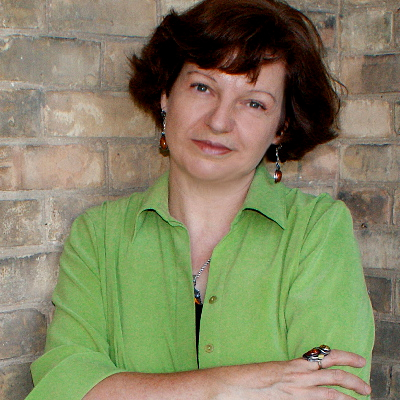
 Deborah Cooke: Author
One response to “The Holy Grail of Voice – Part 1”
Glad to hear you had such a fun time in NJ!
And what a great hook – can’t wait to find out who Herman is?
You are a natural teacher Deborah – will be checking back to read more about voice 🙂
Thanks and take care
LikeLike