This story used to be common knowledge among romance writers, but I guess it’s been lost over the years. I told it when I taught that workshop in January, and only one other author in attendance knew it – so I’ll tell it to you again.
Once upon a time, historical romance as we now know it did not exist as a genre. The only romances were the sweet little contemporary Mills & Boon romances that came out every month. Then, Kathleen Woodiwiss wrote a book called THE FLAME AND THE FLOWER which sold like crazy. We would now call this an historical romance – it was set in England and colonial America, featured a heroine who came into her own over the course of the book and a strong hero, had lots of historical detail (especially social history), lush prose and explicit sex. (Many thought the sex in this book was too explicit – the first intimate act between the hero and heroine is not consensual.) This book sold and sold and sold, effectively launching a genre. There was a lot of trial and error in the subsequent years, as editors and publishers weren’t entirely sure what element of this book (and other books by Woodiwiss) was so resonant for readers, but Woodiwiss always sold well.
At that time, the world was full of independent booksellers and small distributors – the consolidation that has characterized the book business in the past decade hadn’t occurred as yet, and computerized ordering wasn’t even a gleam in anyone’s eye. One thing publishers did figure out during this trial and error period was how to package these books for distribution. There was no romance section, per se, and no expectation that any distributor would order a given number of titles in any month. Meanwhile publishers were printing a lot of these kinds of books, trying to find another Woodiwiss. The smaller and independent bookstores would often buy their stock at local distributors – they would literally walk in, show their tax number, and buy wholesale from what the distributor had in stock.
So, the key to distribution for any given title was getting the books into the smaller distributor warehouses.
Publishers realized that the buyers for these distributors were invariably men – this was the 1970’s, after all – and that having a little skin on the cover ensured better distribution for the book. Publishers had no idea what readers wanted on the package, and really weren’t that interested in marketing directly to the reader then – they wanted the books in the distribution chain. The idea was likely that readers would buy by author, but if an author’s book was never distributed, readers would have no chance to decide whether that author’s work was for them.
So, the “bodice ripper” cover was born.
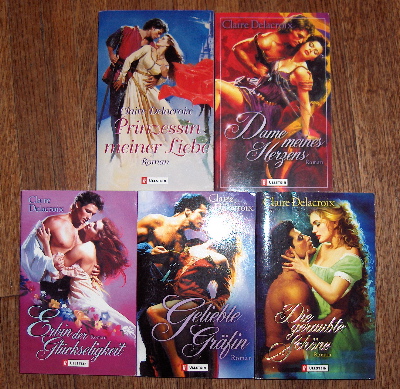
Because I was first published in 1993 – and by a category house – my historicals didn’t have audacious clinch covers. (A couple have pretty chaste embraces, and the Bride Quest books had step-backs.) These are German editions of five of the Bride Quest titles – the sixth title and the reprint of the last title both had landscape covers, i.e. with a castle in the background. Maybe the change in reader expectation reached Germany then. (?) Geliebt Grafin, the one with the flash on the woman’s face, is the most “bodice ripper” cover I’ve ever had. I’m not sure that it was a particularly sexy book, and can’t remember what kind of sales numbers that edition had in Germany.
Those who are outside of the genre don’t always realize that the term “bodice ripper” is derogatory. No romance author calls her work a bodice ripper, or even her cover art bodice ripper. It implies that the book is only about sex – while what characterizes a good romance is a plausible relationship and compelling characters. Art departments call this kind of cover a “clinch”.
Over time, it became clear that readers weren’t necessarily enamoured of the clinch cover – a small industry developed in making little fabric book covers that hid the cover art from view. The step-back cover arrived in the 80’s – this featured a “candy box” or roses and ribbons cover on the outside, with the clinch tucked inside on a second cover. These are expensive to manufacture, though, because the outer cover is often die-cut and the second cover has to be tipped into the book by hand. With the austerity of the late 90’s, these kinds of packages went away. (Another factor leading to their demise was time – it takes time to tip in those stepbacks by hand, and as ordering became more immediate, that time could mean losing the order.)
The clinch cover still exists, in some markets and in some subgenres. There are readers who love the clinch covers – because they are lavish and over the top, because they are romantic, because they evoke a sense of nostalgia for whenever that reader began reading romance. There are others who despise them. To each, her own! I’m not much for them, myself, but they are part of the history of the genre.
So, go ahead and tell me. Did you love the clinch covers? Or did you cover yours up? Did you keep your Woodiwiss books?


 Deborah Cooke: Author
6 responses to ““Bodice Rippers””
My oh my, we Germans, always late. I mean, historical romances here still have bodice ripper covers. Really. Some are really beautiful and very well done art, but actually, I don’t like them so very much. Another reason for me to buy only English books. 😉 I’ve always considered the English covers to be so much more beautiful than the German ones.
Sigh.
I think we’ll never have the kind of covers here that I would like. Unless I start a revolution and change them, hehe. 🙂
LikeLike
Yes, I covered up the clinch covers when out in public. Had to – couldn’t read those books in front of the men I worked with in the military.
LikeLike
Well, I don’t know, Lisa. The last two Bride Quest editions in Germany had those castle-scene covers. I wonder whether you still have a similar distribution network as was once the case in English North America (all those men as buyers!) and that’s why the clinches are still used. (??) When the first three Bride Quest titles went to Moments book club in Germany, they had elegant covers – a string of pearls, for example. Those sales were made direct to consumer, so presumably were a more accurate representation of what readers wanted.
Anything is possible!
LOL Pam. I’ll bet you still got ribbed for your choice of reading material!
LikeLike
Hm, maybe they changed the covers for some authors (and you are one of them!). I only know that the vast majority of historicals (and only those!) still has bodice rippers whereas paranormals for example very much resemble the American ones.
I can tax my brain as much as I want, I don’t see a logic behind that.
Maybe because there isn’t any. Wouldn’t be the first time. Hmmm…
LikeLike
I had the covers for some, and not for others. I vividly remember (and still own) the entire Woodiwiss collection and am pretty sure I found them in The Pam’s collection in the basement. I was fascinated by the story lines, not to mention the sex described.
LikeLike
Bodice Rippers – it didn’t really matter to me one way or another, but when reading in public I very often rolled the cover page over (basically broke the book’s spine), so that it wasn’t visible. I much prefer the current type of covers that are not so explicit. Not because I have a problem with explicitness, but one with the comments I tend to get when reading books with these covers from people who do not read romance normally and usually think that all a romance is is – fluff!!!
By the way..as a fellow knitter, one off topic question – do you know ravelry and are you a memeber?
LikeLike